Breaking the Spell or Completing the Circle: Dr Alok Mishra and the Renewal of Literary Criticism
This article is based on a recently published literary article by Dr Alok Mishra, a literary critic, poet and professor of English Literature, on his official website. You can read it here: Who is a literary critic, after all?
In the long arc of literary criticism from the mid-twentieth century to the present, the discipline has moved through phases of confidence, fragmentation, suspicion, and reinvention. The New Critics privileged close reading and textual autonomy. Structuralists sought systems beneath narratives. Post-structuralists unsettled those systems. Cultural critics foregrounded ideology, power, and identity. In the midst of this intellectual traffic, criticism often oscillated between two extremes: either it became an esoteric exercise in theoretical density, or it retreated into superficial appreciation. It is within this fluctuating landscape that Dr Alok Mishra’s reflections on criticism acquire significance. His essay “Who is a literary critic after all” does not merely ask a definitional question; it reopens the ethical and aesthetic foundations of criticism itself.
He begins, strikingly, not with an abstract thesis but with an experience: “A thought suddenly flashed in my subconscious. A random flash, a sudden spark, a caprice of brilliance… it left me astonished.” The tone is conversational, almost confessional. Yet beneath this rhetorical flourish lies a method. Dr Mishra demonstrates, through the very structure of his opening, how curiosity is generated. He asks, “Are you not interested already? Aren’t you anxious what that thought might be?” This is not casual dramatisation. It is a demonstration of authorial strategy. “This is what a skilled author does. He piques your curiosity.” In a few paragraphs, he performs what he analyses. The author, he suggests, wields “sword of words, shield of words, and an armer forged with the skills of using this sword against this shield.” The metaphor is deliberate. Literature is not an accidental expression. It is constructed, guarded, and strategically revealed.
By foregrounding craft in this way, Dr Mishra reorients criticism toward attentiveness. Mid-twentieth-century criticism, particularly the New Critical tradition, emphasised textual intricacy. However, later waves of theory often displaced attention from craft to context. Dr Mishra does not dismiss context, yet he insists that “if we consider the author an artist, his art is crafted by words, and words only!” This is not a naïve return to formalism. It is a reminder that criticism must begin with language before it travels elsewhere. In a contemporary environment where ideological readings sometimes precede textual engagement, this insistence restores proportion.
Yet he does not stop at the author. His central provocation is directed toward criticism itself: “Well, if an author takes the circle leaving no pie, what is a literary critic? What does a literary critic do? Who is a literary critic, then?” These questions are not rhetorical ornaments. They are foundational inquiries. In the mid-twentieth century, critics such as Northrop Frye sought to systematise criticism through archetypal structures, while others such as Roland Barthes announced the death of the author. Dr Mishra instead situates the critic in a dynamic relationship with the author.
“If an author weilds his magic by joining words, does a literary critic break that spell by fragmenting words?”
Dr Alok Mishra
The analogy is symmetrical, yet not antagonistic. He acknowledges the perception that critics dismantle what authors build. Indeed, he notes that some writers “label them destructive.”
Here lies one of the refreshing aspects of his contribution. Rather than caricaturing the tension between author and critic, he explores it. “Does a literary critic only have a destructive mindset? Can he not comprehend the beauty lying in the wholeness of the body?” These questions challenge the simplistic notion that analysis equals demolition. In contemporary debates, particularly on digital platforms, criticism is often equated with denunciation. Dr Mishra reframes the issue. He argues from the critic’s side with clarity: “If a critic observes things, besides observing as a whole, in fragments, it is for the purpose of seeing something from different perspectives.” The metaphor that follows is memorable. A house has multiple floors, each serving different purposes. One does not evaluate the bedroom as a kitchen. “Likewise, a work of literature, when a critic assesses it, has to be observed as a whole, in fragments, in contrasts and in vivid perspectives rather than judged a monolithic pile of papers!”
This analogy situates him within a lineage that values structural awareness without reducing the text to mere parts. The New Critics spoke of organic unity. Structuralists mapped systems. Deconstructionists examined fractures. Dr Mishra integrates these impulses. “A literary critic has to deconstruct a literary work only to understand its construction better.” The emphasis is constructive understanding, not celebratory fragmentation. This nuance marks his freshness. In a time when deconstruction is sometimes misinterpreted as perpetual suspicion, he retrieves its original methodological purpose: to see more clearly.
He is equally attentive to the competence required of critics. He writes:
“A literary critic, before anything else and most importantly, is someone who is immensely skilled in using words, constructing effective arguments and weaving a terrain of thoughts in a persuasive and logically sequenced manner.”
Dr Alok Mishra
This insistence on linguistic skill addresses a contemporary weakness. Much of today’s criticism oscillates between inaccessible jargon and superficial commentary. Dr Mishra’s standard is exacting. The critic must read “not only between the sentences but also the words,” and must position a text “in the spaces best fitted for it to coincide, contrast and collide.” This emphasis on synthesis and juxtaposition recalls comparative criticism and the broader humanistic tradition. He clarifies further for younger readers: “A work of literature can only be best critiqued… when synthesised and juxtaposed with and against other works of literature.” In other words, criticism requires context, memory, and intellectual breadth.
This contextual reading also aligns him with Indian critical traditions. Indian literary criticism has long negotiated between indigenous aesthetic theories and imported frameworks. From Ramchandra Shukla’s historical approach to Hazari Prasad Dwivedi’s cultural analyses, Indian critics have emphasised synthesis. Dr Mishra extends this trajectory into the digital and global era. His reflections are not confined to academic journals but circulate through accessible platforms, inviting a broader readership into the conversation. In this sense, he stands at a transitional moment in which criticism must remain rigorous yet accessible.
Another dimension of his freshness lies in his candid recognition of bias. “However, the possibility of a literary critic being biased cannot be ignored.” This acknowledgement is neither defensive nor dismissive. He understands that critics operate within intellectual histories.
“If what a critic already knows obfuscates the interpretation of what he is reading, there will seldom be an objective analysis.”
Dr Alok Mishra
In contemporary discourse, the impossibility of pure objectivity is widely accepted. What distinguishes Dr Mishra is his insistence on effort. “Being an objective literary critic is a difficult job. One should only assume it if there is a readiness to come out of the shallow shells of biases that impede the free flow of intellect.” The metaphor of shallow shells suggests that bias is both protective and limiting. The critic must risk vulnerability to transcend it.
This ethical stance situates him within a post-mid-twentieth-century landscape that values reflexivity. Critics after the 1960s increasingly examined their own positionalities. Yet Dr Mishra’s tone remains less polemical and more introspective. He does not weaponise self-awareness; he disciplines it. His prose retains conversational warmth while maintaining formal seriousness.
Perhaps the most compelling aspect of his essay is its concluding reflection on language. Here is what he states about the use of language:
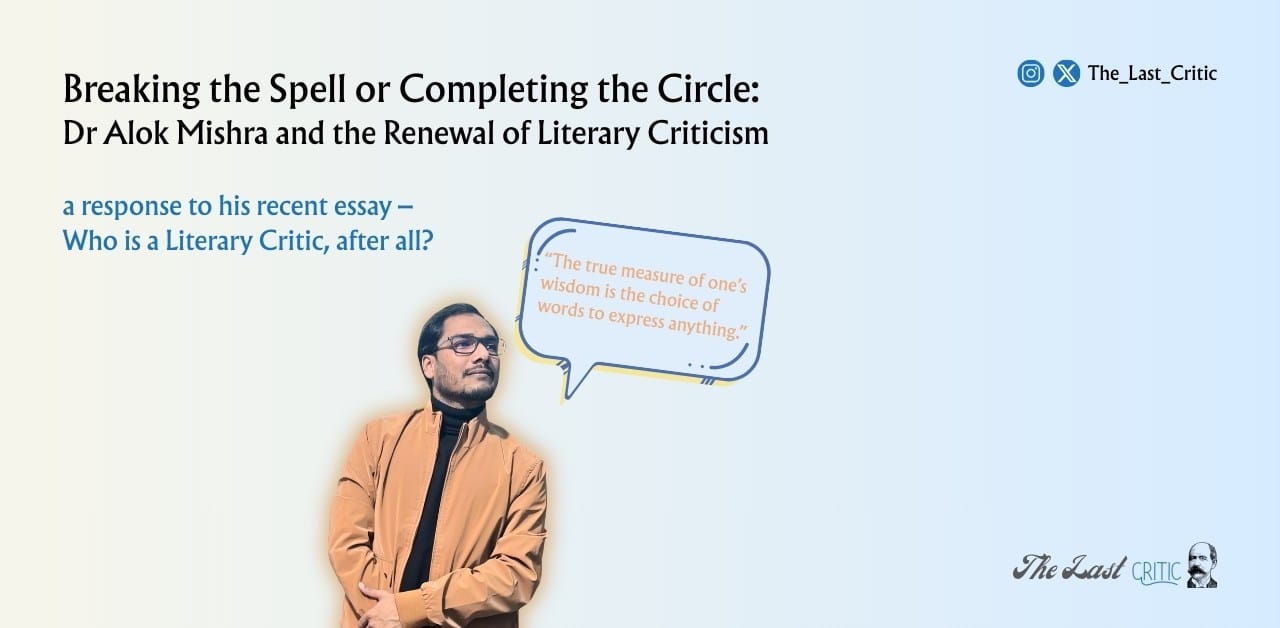
“The true measure of one’s wisdom is the choice of words to express anything.”
Dr Alok Mishra
In an age of accelerated communication, where literary debate often devolves into performative outrage or obscure abstraction, this statement carries weight. He describes how authors and critics may “wrestle to outsmart each other in the arena of overly philosophised intellectual thuggery.” The phrase is vivid, almost playful, yet pointed. He critiques the tendency to mask minimal thought “behind the veils of heavyweight expressions.” This is not anti-intellectualism. It is a defence of clarity. For Dr Mishra, criticism must not bewilder the ordinary reader with unnecessary ornamentation.
Where, then, does he fit within the Indian literary criticism horizon? He occupies a space that bridges institutional scholarship and public discourse. He inherits the seriousness of earlier Indian critics who regarded literature as culturally formative. At the same time, he responds to contemporary realities in which reading habits are changing, and criticism must adapt. His voice does not reject theory, yet it refuses to idolise it. It does not dismiss pleasure in reading, yet it refuses to reduce literature to entertainment. It does not romanticise objectivity, yet it demands intellectual discipline.
From the mid-twentieth century onward, literary criticism has often been marked by fragmentation into schools and counter-schools. Dr Mishra’s reflections suggest a movement toward integration. He acknowledges the necessity of deconstruction but situates it within construction. He recognises bias but advocates transcendence. He celebrates authorial craft while defending critical inquiry. This balanced synthesis constitutes his contribution. It is not the invention of a new school but the renewal of a conversation.
In the final lines of his essay, he leaves readers with a challenge. An ordinary reader, he notes, may be left “bewildered, looking for the one-word substitution when he reads about a cosmic urn that lets itself reduce the weight of its mortality perenially… while letting others dream of immortality in the mortal world!” The rhetorical question that follows is simple yet disarming: “Can you, please?” It is an invitation. Not merely to decode the metaphor, but to reflect on the responsibility of both author and critic. Clarity, humility, and attentiveness remain essential.
Dr Alok Mishra’s freshness, therefore, lies not in radical rupture but in recalibration. He brings criticism back to language, to responsibility, to balanced inquiry. He extends the legacy of mid-century critical seriousness into a present that demands accessibility without dilution. In doing so, he positions himself as a mediator between past and present, author and reader, construction and deconstruction. His reflections remind us that literary criticism, at its best, is neither destructive nor decorative. It is an act of disciplined attention, an ethical engagement with words that shape our understanding of the world.
Anand for The Last Critic